The Sound That Changes the Map
Artillery is the oldest “long arm” on the battlefield, yet it remains one of the most modern. When a cannon fires today, it’s not just a loud metal tube hurling an explosive shell. It’s a system—an ecosystem of sensors, calculations, communications, logistics, and disciplined crews turning distance into pressure. Modern cannons shape warfare because they can influence a fight without seeing it. They can break up an assault before it forms, seal off escape routes, or carve a corridor of smoke so friendly forces can move. In many wars, artillery doesn’t merely support the maneuver plan; it becomes the maneuver plan. This is why artillery is sometimes called the “king of battle.” Not because it’s glamorous, but because it’s relentless. In the age of drones, satellite imagery, and precision targeting, artillery has evolved into a weapon that can be both brutal and exact. It can crush, disrupt, and deny. It can also deliver a single round with purpose. The modern cannon is not defined only by caliber, but by speed of decision and accuracy of information.
A: Faster fire control, better sensors, improved mobility, and more precise effects.
A: Not always—self-propelled systems add mobility and protection, while towed guns can be cheaper and easier to deploy.
A: Counter-battery threats and drones can punish static firing positions quickly.
A: No—smoke, illumination, and specialized fuzes can be mission-defining.
A: Observers and sensors provide coordinates, and computers generate firing solutions.
A: Poor target data, weather effects, barrel wear, and weak coordination.
A: Yes, especially with strong ISR and precision munitions or advanced fire control.
A: Ammunition resupply and logistics tempo.
A: They augment them—human judgment and coordination remain crucial.
A: Cannons are responsive, scalable, and economically sustainable for prolonged operations.
What “Artillery Systems” Really Means
When people hear “artillery,” they often picture a howitzer and a plume of smoke. In military reality, an artillery system includes every step between deciding to fire and delivering effect on target. That system starts with detection: a forward observer, a drone feed, a radar track, or a reconnaissance unit calling in coordinates. Then comes processing: confirming what the target is, ensuring it’s legitimate and relevant, choosing the right ammunition and firing unit, and clearing the shot to avoid friendly fire or civilian harm. Finally comes execution: the gun crew receives the mission, lays the cannon, fires, and adjusts if necessary. After that, survivability actions begin—because modern battlefields punish static positions.
Artillery systems also include resupply, maintenance, and mobility. A cannon with no shells is a sculpture. A battery that cannot move is a target. A unit with great range but poor coordination is noise. In modern warfare, the gun is only the final link in a chain. The chain is where most of the advantage lives.
The Modern Cannon Family: Towed, Self-Propelled, and Beyond
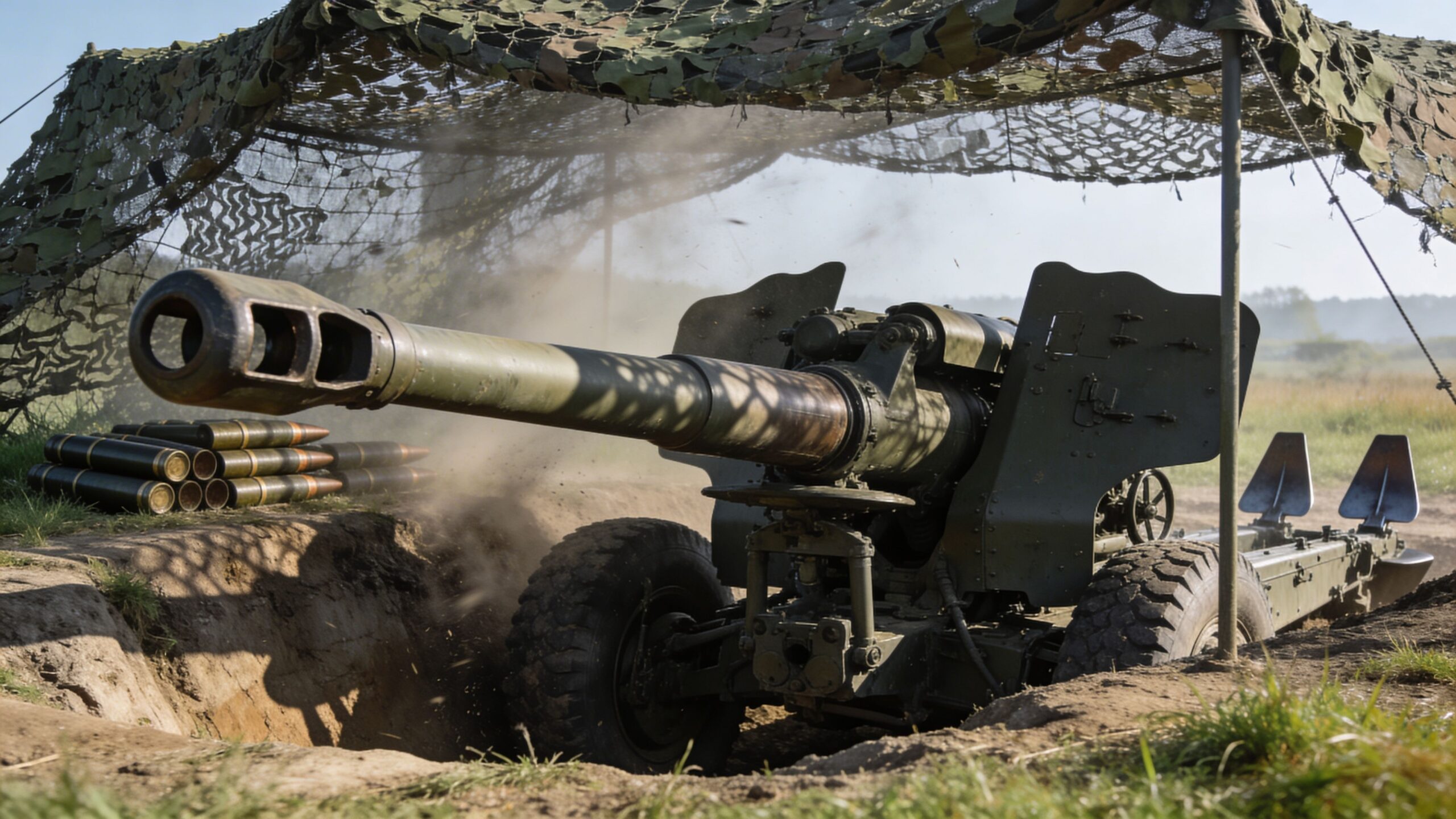
Modern cannons are typically found in two main forms: towed and self-propelled. Towed artillery is hauled into position by a truck, then emplaced on the ground. It can be lighter, cheaper, and easier to transport strategically. It can also be highly accurate and lethal when well-trained crews operate it. Its limitation is time: emplacing and displacing takes longer, and in a world of drones and counter-battery radars, time is exposure.
Self-propelled artillery mounts the cannon on an armored vehicle, often tracked, sometimes wheeled. It brings mobility and protection to the gun crew and typically enables faster “shoot-and-scoot” tactics. Because the platform can move quickly after firing, it can survive longer against a capable enemy who hunts for firing positions. Self-propelled systems also often integrate advanced digital fire control and automation that reduces the time between receiving a mission and firing the first round.
Beyond these, modern armies also use specialized cannon systems such as naval guns adapted for coastal defense, truck-mounted howitzers designed for rapid deployment, and air-portable lightweight guns for mountain and expeditionary operations. What unites them is not their chassis, but their role: delivering indirect fire with speed, coordination, and effect.
Indirect Fire: Winning Without Line of Sight
A modern cannon’s defining feature is indirect fire. It does not need to see the target, and the target often does not know the gun exists until the first shell arrives. Indirect fire works through geometry and data. A firing solution calculates elevation, direction, propellant settings, and corrections for wind, temperature, barrel wear, and even the Earth’s rotation in some long-range contexts. That calculation used to be done by hand, with tables and experience. Today it is often done in seconds by computers, with systems that translate coordinates into firing commands.
This ability changes tactics. Infantry can fix an enemy in place, and artillery can finish the fight from miles away. Armor can maneuver under a smoke screen created by artillery. A commander can deny a road or a bridge crossing by placing precise fire onto approach routes. Artillery turns terrain into an obstacle course because it can “touch” the battlefield anywhere within range.
Range Isn’t the Only Metric—But It’s Still a Big One
Modern cannons have pushed range further than many people realize, especially when paired with advanced shells and longer barrels. Range matters because it expands the “bubble” of influence a unit can exert. It can force an enemy to relocate command posts, disperse ammunition dumps, and rethink assembly areas. It can also create dilemmas: if you move supplies far back to stay safe, your front line may run short; if you keep them close, they are vulnerable. Yet range is only one part of the equation. A long-range gun that fires slowly, cannot move, or lacks good targeting is less decisive than a slightly shorter-range system that can respond fast, survive counter-fire, and coordinate with reconnaissance. Modern warfare is often about tempo: how quickly you can detect, decide, and deliver effects. Cannons shape warfare when their range is matched by speed and intelligence.
Precision: The New Artillery Reputation
Artillery has long carried a reputation for area bombardment—devastating, but blunt. Modern cannon systems can still mass fires, and in many situations, volume remains essential for suppression. But precision has become a defining feature of modern artillery identity. Precision-guided shells and improved fire control allow a battery to aim for specific points rather than broad areas. Even conventional shells, when fired with accurate data and modern computation, can be remarkably consistent.
Precision changes operational thinking. Instead of “blanketing” a grid square, commanders may aim to neutralize a specific logistics vehicle, a small fortified position, or a particular choke point. This can reduce the number of rounds required to achieve an outcome, which matters both tactically and logistically. Precision also increases the importance of target confirmation. A precise round on the wrong target is worse than wasted—it can be catastrophic strategically.
Rate of Fire, Sustainment, and the Reality of Volume
While precision has evolved, volume remains artillery’s heartbeat. Cannons can fire repeated missions across many hours, adjusting quickly as the fight changes. Rate of fire helps suppress an enemy, disrupt their movements, and prevent them from regrouping. Even when precision munitions exist, the cost and availability may limit their use. Traditional shells remain the bulk of most artillery ammunition because they can be produced and stockpiled at scale. This is where modern cannon systems retain an advantage over many rocket systems: sustained fire. A well-supplied gun line can keep pressure on enemy positions, provide smoke screens, and deliver consistent support to troops in contact. That sustained support shapes the psychology of war. When a unit knows artillery can respond quickly and repeatedly, it changes how they move, how they dig in, and how they decide.
Counter-Battery Warfare: The Artillery Duel
Modern cannons shape warfare not only by what they hit, but by how they survive. Counter-battery warfare is the duel between artillery forces. When one side fires, the other side tries to locate the firing position and respond before the guns move. Counter-battery radars can track shell trajectories backward to estimate launch points. Drones can observe flashes or movement. Signals intelligence can catch communications. In this environment, artillery units must treat time as armor.
Survivability has become a core design and training focus. Guns fire, displace, camouflage, and reappear elsewhere. Batteries operate dispersed rather than clustered. Deception becomes part of the system—dummy positions, decoys, false tracks, and strict discipline about signatures. A modern cannon is lethal only if it is alive, and staying alive requires constant movement and thoughtful concealment.
Sensors: The Eyes That Feed the Guns
Modern artillery’s true revolution is not just in barrel engineering, but in sensors. Drones provide real-time imagery and target confirmation. Forward observers use digital tools to send coordinates quickly. Radar detects incoming fire and can cue counter-battery missions. Reconnaissance teams feed information that can be turned into fire missions within minutes or seconds. This sensor integration turns artillery into a responsive, almost conversational weapon. Spotters see movement, artillery responds, the enemy reacts, and the sensor observes again. This feedback loop makes cannons feel “smarter,” even though the intelligence is distributed across people and systems. When executed well, it creates a battlefield where enemy movement is expensive and exposed.
Ammunition: The Real Personality of a Cannon
A cannon is defined by what it fires. Ammunition choices determine whether artillery acts as a hammer, a scalpel, or a curtain. High explosive rounds deliver fragmentation and blast. Smoke rounds obscure observation and break enemy targeting. Illumination rounds expose night movements and deny concealment. Specialized munitions can shape effects further, and modern fuzes can alter how a round detonates—on impact, after a delay, or in the air to maximize fragmentation coverage.
The ammunition ecosystem also affects logistics and doctrine. A unit with abundant standard rounds can sustain operations, while a unit with limited precision rounds must choose targets carefully. The best artillery units treat ammunition as a toolkit rather than a single blunt instrument, matching effects to intent.
Mobility and Terrain: Where Cannons Fight Best
Cannons are not magical; they are constrained by terrain. Mud, snow, mountains, and road networks shape where artillery can be deployed and how quickly it can move. Self-propelled systems handle many terrain challenges better, but they also require more maintenance and fuel. Towed guns can be surprisingly flexible, but they depend on towing vehicles and time to emplace. In modern operations, mobility is also strategic. Cannons must be able to reposition as the front line moves, as enemy sensors shift, and as new targets emerge. Artillery that cannot keep up with maneuver forces becomes irrelevant. Artillery that moves too predictably becomes a casualty.
Artillery’s Role in Modern Combined Arms
Modern cannons shape warfare most decisively when paired with combined arms doctrine. Infantry fixes the enemy, armor maneuvers, engineers breach obstacles, air defense protects the force, and artillery shapes the space where all of that happens. Artillery can isolate a battlefield by striking routes and bridges. It can blunt enemy reinforcements. It can support assaults by suppressing defenders. It can cover withdrawals with smoke and harassment fire.
The modern concept of “fires” often merges artillery with other strike options, including rockets, missiles, and air-delivered munitions. Even in that broader fires universe, cannons remain essential because they are responsive, scalable, and capable of sustained operations. They are the fire support that can be called again and again.
The Future Cannon: Automation, Networking, and Survivability
The future of cannon artillery is not simply bigger calibers. It’s smarter integration. Automation can speed loading, reduce crew fatigue, and increase consistency. Networking can shorten the path from sensor to shooter. Improved mobility and signature management can enhance survivability. Counter-drone measures may become standard as aerial surveillance becomes ubiquitous. Some concepts also explore advanced projectiles that extend range or improve precision while maintaining the economic advantages of tube artillery. Yet the core truth remains: artillery is a human system. A brilliant cannon is limited by poor training or weak coordination. A modest cannon becomes decisive when crews are disciplined, observers are skilled, and logistics are steady. Modern cannons shape warfare because they turn the chaos of the battlefield into a controllable pressure point—one mission at a time.
Why Cannons Still Decide Wars
Modern warfare is packed with new technologies, but cannons remain central because they deliver reliable, scalable, repeatable power. They can mass effects, or apply precision. They can respond quickly, or sustain pressure. They can deny terrain, break momentum, and create opportunities for maneuver forces to win.
When you understand artillery systems as more than barrels—when you see them as networks of sensors, crews, calculations, and logistics—you see why modern cannons still shape warfare. They are not relics. They are a living, adapting force that continues to define the rhythm of battle.