The Armored Promise—and the Missile Built to Break It
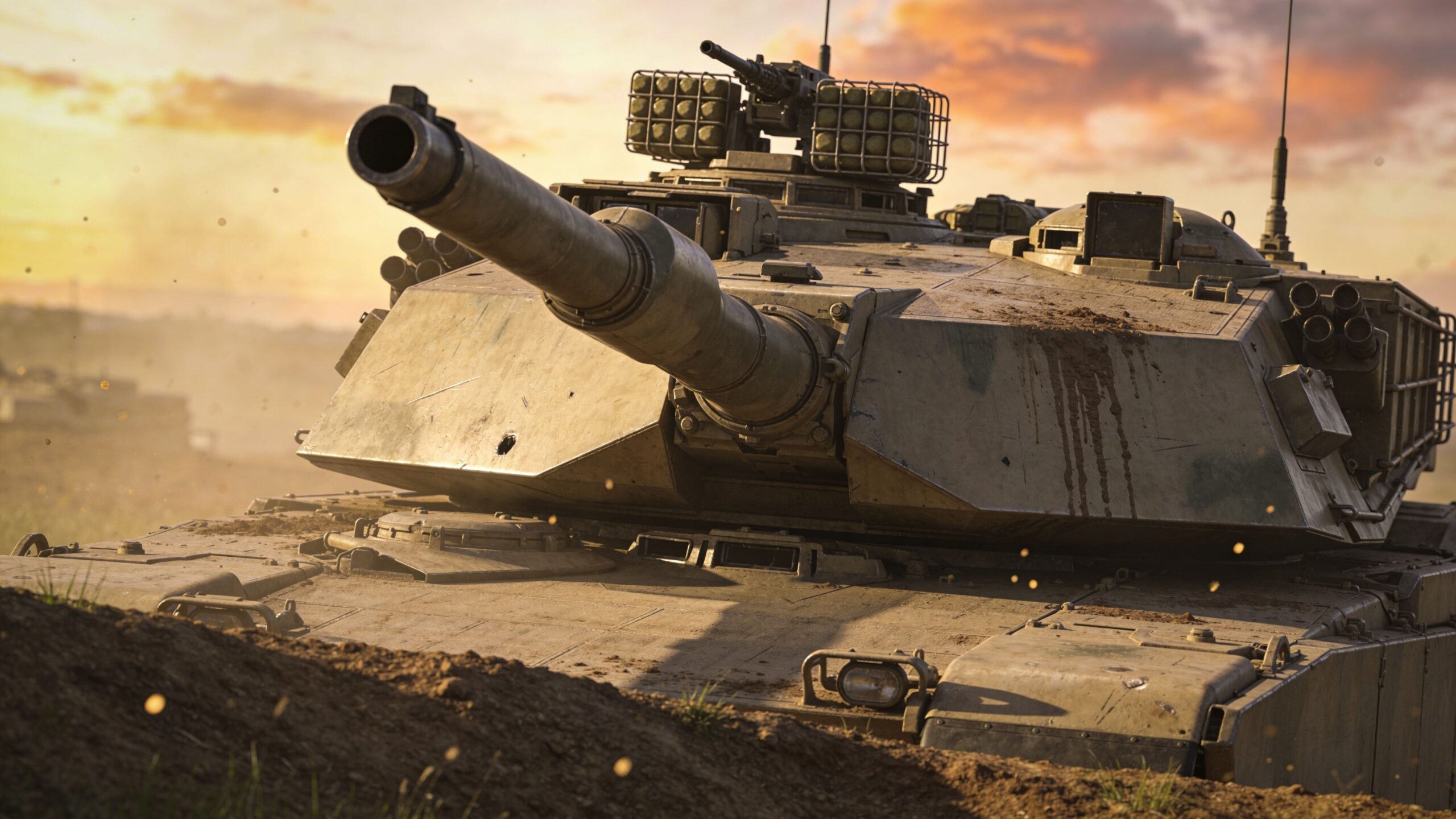
Tanks were created to do something almost mythical in ground warfare: cross deadly ground while absorbing punishment that would shred anything else. A main battle tank’s silhouette tells you the story before it ever fires a shot—sloped plates, thick turret cheeks, heavy tracks, and a posture that says, “I’m still coming.” For decades, that promise shaped doctrine. If you had tanks, you could punch through lines, hold key terrain, and force an enemy to respond. Anti-tank missiles were invented to challenge that promise. They are not just weapons; they are a philosophy of denial. They tell infantry and light forces, “You don’t need your own tank to stop a tank.” The evolution of anti-tank guided missiles (ATGMs) has turned the battlefield into a contest between penetration and protection, between guidance and countermeasures, between the hunter’s patience and the tank crew’s discipline. Understanding how missiles destroy heavy armor—and how tanks survive—isn’t about glorifying destruction. It’s about grasping the physics, tactics, and systems that define modern armored warfare.
A: Not always—many hits cause mobility or mission kills rather than total destruction.
A: They exploit thinner roof armor and can damage critical turret systems.
A: No—tandem warheads and angle choices are designed to overcome reactive tiles.
A: A defensive system that detects and disrupts or intercepts incoming anti-tank threats.
A: Yes—smoke can break line-of-sight and disrupt guidance or target tracking.
A: Infantry screens close terrain where missile teams can hide and ambush.
A: They are typically less protected than the front arc, which is heavily reinforced.
A: They increase risk, but tanks adapt with tactics, countermeasures, and better awareness.
A: Detect them early, suppress them quickly, and avoid predictable exposure.
A: They provide protected firepower and shock effect—when used with combined arms discipline.
What an Anti-Tank Missile Is Really Trying to Do
A tank is not uniformly armored. It’s a machine that balances protection, firepower, mobility, and crew survivability inside a weight limit that still has to move across bridges and mud. That means armor is concentrated where threats are expected: thick turret fronts, reinforced glacis plates, and layered protection around the crew compartment. Other areas are less protected, not because engineers are careless, but because physics demands tradeoffs.
An anti-tank missile’s job is to exploit those tradeoffs. It aims for angles, zones, and moments where the tank’s protection is weakest or least prepared. The missile’s lethality is not simply “bigger explosion.” It’s controlled energy, shaped and delivered in a way that overwhelms armor design assumptions.
Most modern anti-tank missiles also bring a second advantage: guidance. Unlike an unguided rocket that relies on distance and luck, an ATGM can be steered to a target, correcting in flight. That transforms anti-armor combat from a short-range brawl into a long-range, patient hunt.
Shaped Charges: The Science Behind Armor Penetration
The most famous anti-tank mechanism is the shaped charge, often associated with the term HEAT: High-Explosive Anti-Tank. The key idea is counterintuitive. A shaped charge does not “blast” armor open in the traditional sense. Instead, it uses an explosive to form a focused jet of metal and energy that punches through armor by concentrating force into an extremely small area.
This jet behaves less like a typical explosion and more like a hyper-accelerated, focused tool. It doesn’t need a huge warhead to be deadly. It needs proper design and correct detonation distance, which is why you’ll hear about standoff distance in anti-tank discussions. The shaped charge performs best when it detonates at a specific distance from the armor, allowing the jet to form and stabilize before impact. This is also why some tank defenses look “odd” to civilians, like cage armor or slat armor. They can disrupt the shaped charge’s timing, forcing it to detonate too early or deforming the warhead so the jet forms poorly. It’s not a perfect shield, but it can reduce lethality in the right conditions.
Tandem Warheads: Beating Reactive Armor
Once shaped charges became common, tanks responded with explosive reactive armor, often abbreviated as ERA. Reactive armor typically uses plates and explosive elements designed to disrupt the shaped charge jet. When a shaped charge strikes, the reactive tile detonates outward, interfering with the jet’s coherence and reducing penetration.
Missile designers responded with tandem warheads: two shaped charges in sequence. The first “precursor” charge triggers the reactive armor, and the second main charge strikes the now-exposed base armor. It’s a straightforward concept with complex engineering behind it, because timing matters. If the second charge fires too early, the reactive armor’s movement may still disrupt it. If it fires too late, the missile may lose optimal geometry.
Tandem warheads represent the arms race in its purest form: defense inspires offense, which inspires new defense. Each innovation is a temporary advantage, not a permanent solution.
Top-Attack: Turning the Weakest Angle into the Main Plan
A major vulnerability in tank design is the roof. Tanks are built to face threats from the front and sides. Historically, the most dangerous hits came from direct-fire weapons and other tanks, striking at roughly the same elevation. Roof armor is generally thinner because thick roof plating would add enormous weight while providing diminishing returns against older threats.
Modern anti-tank missiles exploit this with top-attack profiles. Instead of slamming into the tank’s front arc, the missile climbs and strikes down onto the turret roof or engine deck. This is devastating not only because the armor is thinner, but because the roof often contains critical systems: optics, sensors, hatches, and components essential for the crew to fight. Top-attack is also psychologically powerful. It tells tank crews that danger is no longer limited to the horizon. The threat can come from above, guided by a weapon you may never see until it’s too late.
Line-of-Sight and Guidance: The Missile’s Real Superpower
A missile’s warhead is only half the story. The other half is guidance—the ability to stay on target despite wind, movement, and imperfect launch conditions. Older systems required the operator to steer the missile all the way to impact, keeping the target in the sight while the missile flew. That demanded training, calm, and time under fire.
Modern systems often reduce this burden. Some missiles can lock onto a target and guide themselves. Others use advanced tracking that makes operator input less demanding. The practical effect is that missile teams can fire from safer positions, at longer distances, and with higher hit probability.
Guidance also enables smarter attack choices: striking from angles, timing an approach, or using flight profiles that reduce exposure to counterfire. In a battlefield saturated with sensors, the side that can strike quickly and then relocate has a profound advantage.
So How Do Tanks Survive? The First Answer Is “They Don’t Travel Alone”
The popular image of a tank as a lone beast is misleading. Modern tanks survive through combined arms. Infantry screens the close terrain where missile teams hide. Reconnaissance units detect threats before the tank rolls into them. Artillery suppresses likely launch points. Engineers clear obstacles that force tanks into predictable lanes. Air defense discourages the drones that cue missile strikes. The tank is powerful, but it is not self-sufficient.
This is the first survival lesson: a tank that is unsupported is a tank that is being invited into an ambush. Anti-tank missiles thrive on isolation. They reward the enemy who can force a tank into a narrow road, a blind corner, or a ridge line that exposes the hull. The “survival” of armor is as much about formation, discipline, and information as it is about steel.
Armor Isn’t One Thing: Composite, Spaced, and Angled Protection
Modern tank armor is rarely just thick steel. Composite armor layers materials to defeat different threats. Some layers disrupt shaped charge jets; others slow kinetic penetrators; still others manage fragments and spall to protect the crew. Spaced armor adds distance to reduce shaped charge effectiveness by forcing the jet to form and dissipate before reaching the main armor layer.
Angling matters too. Sloped armor increases effective thickness and can cause projectiles to deflect. It also changes the geometry for shaped charges, which are most effective when striking perpendicular to a surface. Tanks exploit this with turret shapes and frontal arcs designed to maximize survivability in expected engagements.
No armor is invincible. The goal is not invulnerability; it’s survivability—absorbing enough punishment for the crew to fight, withdraw, and live.
Explosive Reactive Armor: The Sacrificial Shield
ERA is one of the most visible modern tank defenses. It looks like blocks or tiles attached to the tank’s exterior, and that’s essentially what it is: modular protective “layers” meant to be sacrificed. By detonating outward when struck, reactive armor can reduce shaped charge penetration and sometimes affect other threats depending on design.
ERA’s strengths are its modularity and cost-effectiveness compared to redesigning entire hulls. Its limitations are also real. Tandem warheads exist specifically to defeat it, and ERA can be damaged or depleted over time. It also introduces risks in close infantry operations, where explosive tiles can be hazardous to nearby friendly troops if they detonate. Even so, reactive armor remains a key part of modern tank survivability packages because it improves odds in a world where shaped charges are common.
Active Protection Systems: “Hard Kill” and “Soft Kill” Defense
Where armor and ERA are passive defenses, active protection systems (APS) are active defenses—systems that detect incoming threats and attempt to defeat them before impact. APS generally falls into two broad categories.
Soft-kill systems aim to confuse or break the missile’s guidance. They may use smoke, aerosols, electronic countermeasures, or other techniques to disrupt tracking. If a missile can’t see or track its target, it may miss or fail to execute a proper top-attack profile.
Hard-kill systems attempt to physically intercept or destroy the incoming projectile using countermeasures launched from the tank. This is a high-speed, high-stakes duel measured in fractions of a second. If it works, it can prevent a catastrophic hit. If it fails, the tank still relies on its armor and crew survivability.
APS represents one of the most significant shifts in armored warfare: the tank is no longer just a passive recipient of incoming fire. It becomes a reactive participant in its own defense.
The Tank’s Best Defensive Weapon: Movement and Discipline
Even the best armor can be defeated if the tank is predictable. Many successful anti-tank engagements rely on the same fundamentals: the tank stops in a known lane, exposes its side, crests a ridge in silhouette, or lingers in an open area while being observed. Missile teams live for predictability, because it lets them prepare range, line of sight, and escape routes.
This is why tank tactics emphasize movement, cover, concealment, and timing. Hull-down positions protect the hull while allowing the turret to engage. Bounding movement reduces exposure time. Smoke can break observation. Rapid repositioning denies the enemy a stable targeting picture.
In a world where drones can hover and watch, discipline also means signature control—limiting thermal and visual cues, avoiding unnecessary movement patterns, and treating every pause as a potential aiming window for an enemy missile team.
Drones and the Modern Anti-Tank Ecosystem
Anti-tank missiles do not exist in isolation anymore. They are often part of a larger ecosystem where drones spot, track, and cue missile teams. A drone can find a tank column, follow it, and guide fires onto it from beyond the tank’s line of sight. That changes the defensive problem. The tank isn’t just worried about the missile. It’s worried about the observation that makes the missile possible.
This is why modern armored survival increasingly includes counter-drone awareness, electronic measures, and integrated air defense. Tanks survive when they deny the enemy the ability to see them long enough to aim and coordinate.
The Real Outcome: Mobility Kill vs Catastrophic Kill
Not every anti-tank hit results in a dramatic explosion. Many engagements result in a mobility kill—damaging tracks, suspension, or engine systems so the tank can’t move. A mobility-killed tank may still be armed and dangerous, but it becomes easier to target again. Other hits cause mission kills, disabling the turret, optics, or crew systems. The worst-case scenario is a catastrophic kill, where the vehicle is destroyed and the crew’s survival is severely threatened. This range of outcomes matters because it shapes both tactics and perception. A tank “surviving” might mean the crew escapes and the vehicle is recovered later. Survivability is not always about keeping the tank operational; it can be about saving the crew and preserving combat power over time.
The Arms Race That Defines Ground Warfare
Anti-tank missiles destroy heavy armor by exploiting physics and geometry—shaped charges, tandem warheads, top-attack profiles, and guided precision. Tanks survive through layered defense: composite armor, reactive tiles, active protection systems, and the most important layer of all—combined arms tactics, movement discipline, and situational awareness.
The battle between missile and tank is not a story of one replacing the other. It’s a story of adaptation. As missiles evolve, tanks evolve. As tanks evolve, missiles evolve again. In the middle are the crews, the planners, and the battlefield realities that decide which side makes fewer mistakes when seconds matter.