The Tensions That Set the Stage
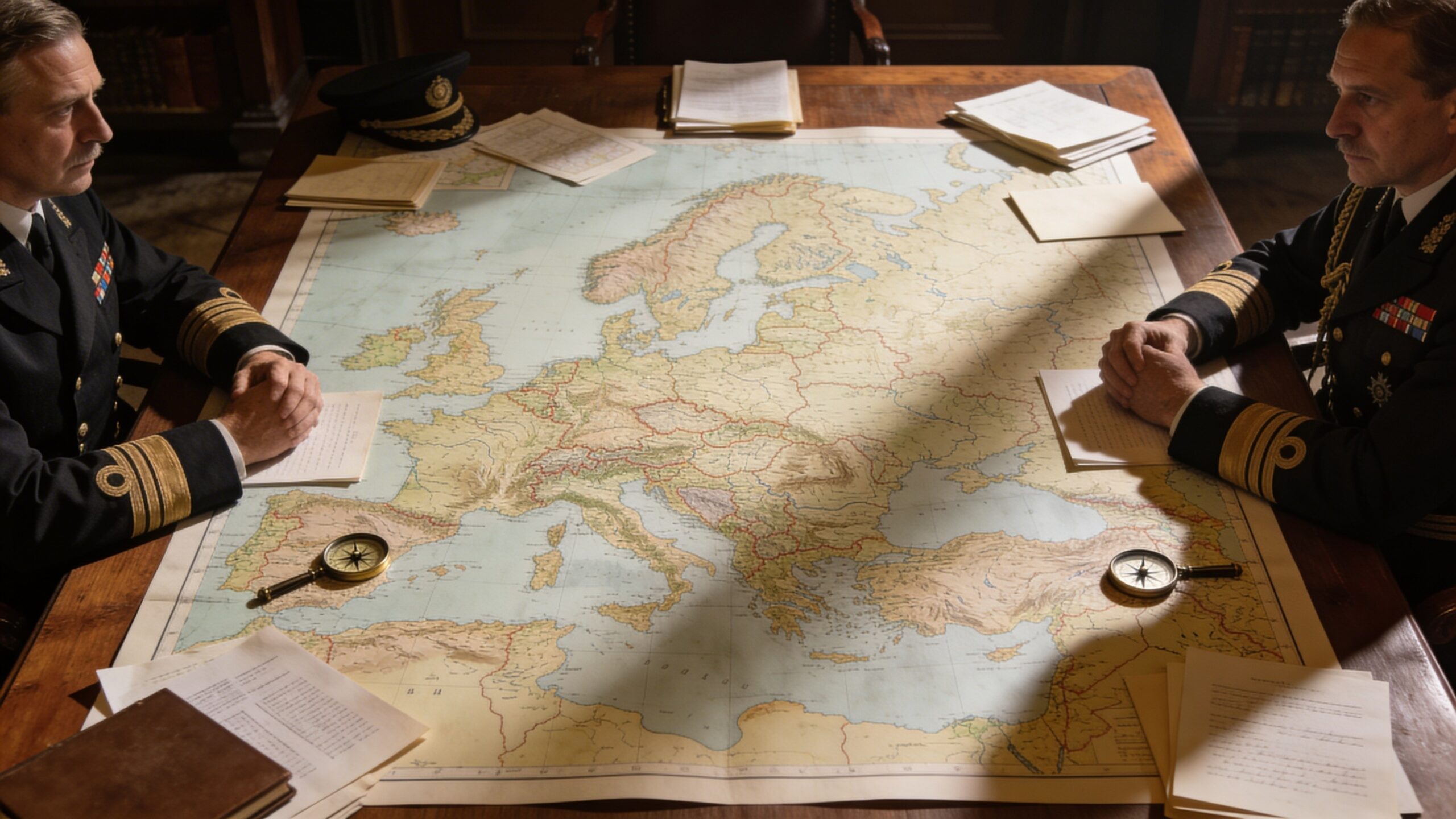
At the beginning of the twentieth century, Europe appeared powerful and stable. Industrial progress had accelerated economic growth, global trade was expanding, and empires dominated large portions of the world. Beneath the surface, however, rivalries between nations were intensifying. Military buildups, territorial disputes, and complex alliances created a fragile balance of power that could collapse with a single spark. Nationalism had become a powerful force throughout Europe. Ethnic groups sought independence, and nations competed for prestige and influence. Germany had emerged as a powerful industrial and military state, challenging the dominance of Britain and France. Austria-Hungary struggled to control nationalist movements within its diverse empire. Meanwhile, Russia supported Slavic independence movements in Eastern Europe, adding another layer of tension. A complex system of alliances further heightened the risk of conflict. Germany and Austria-Hungary were aligned through the Central Powers, while France, Russia, and Britain formed the foundation of the Allied coalition. These alliances were intended to prevent war through deterrence, yet they also ensured that if conflict began, it could spread rapidly across the continent. By 1914, Europe was effectively a powder keg waiting for ignition.
A: The assassination of Archduke Franz Ferdinand in Sarajevo triggered the diplomatic crisis that led to war.
A: Defensive weapons like machine guns and artillery made open advances extremely deadly.
A: The United States entered the conflict in April 1917.
A: Submarines targeted merchant shipping and disrupted global supply lines.
A: Tanks, chemical weapons, and military aviation all emerged during the conflict.
A: It became one of the longest and most symbolic battles of the war.
A: Germany agreed to an armistice with the Allied powers on November 11, 1918.
A: The Treaty of Versailles reshaped borders and imposed penalties on Germany.
A: Millions of soldiers and civilians were killed or wounded worldwide.
A: The war reshaped global politics and set the stage for future conflicts.
The Spark That Ignited the War
The event that triggered World War I occurred on June 28, 1914, in Sarajevo. Archduke Franz Ferdinand of Austria-Hungary, heir to the imperial throne, was assassinated by a nationalist linked to Serbian independence movements. The assassination shocked Europe and set off a diplomatic crisis.
Austria-Hungary viewed the attack as an act of aggression supported by Serbia. With Germany’s backing, Austria-Hungary issued an ultimatum demanding concessions from the Serbian government. Serbia accepted most demands but rejected several key conditions that threatened its sovereignty. In late July 1914, Austria-Hungary declared war on Serbia. What might have remained a regional conflict quickly escalated because of the alliance system. Russia mobilized to support Serbia. Germany declared war on Russia and then on Russia’s ally France. Within weeks, the major powers of Europe were at war.
The Great War had begun.
The Rapid Escalation of 1914
Germany’s military leadership had prepared for the possibility of war with a strategy known as the Schlieffen Plan. The plan aimed to defeat France quickly before turning east to confront Russia. German forces advanced rapidly through Belgium in order to bypass French defenses. This invasion of Belgium drew Britain into the conflict, as Britain had pledged to defend Belgian neutrality. Soon the war expanded beyond continental Europe.
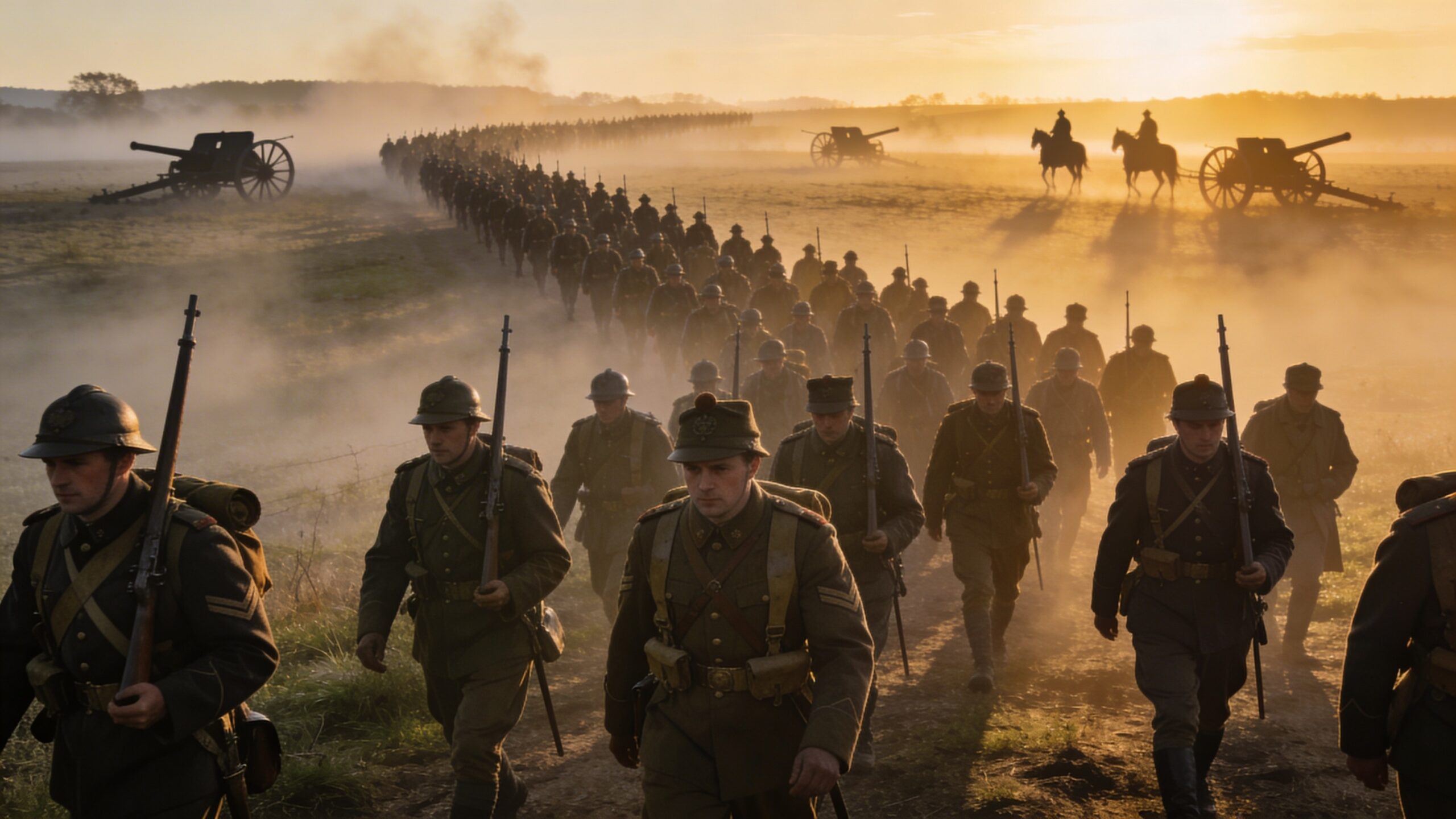
In the early months of the conflict, armies maneuvered rapidly across open battlefields. German forces approached Paris, while French and British troops attempted to halt the advance. The First Battle of the Marne in September 1914 became a crucial turning point. Allied forces managed to stop the German offensive and push the invaders back. After the battle, both sides began digging extensive trench systems along the Western Front. What began as a war of movement soon turned into a war of endurance.
The Emergence of Trench Warfare
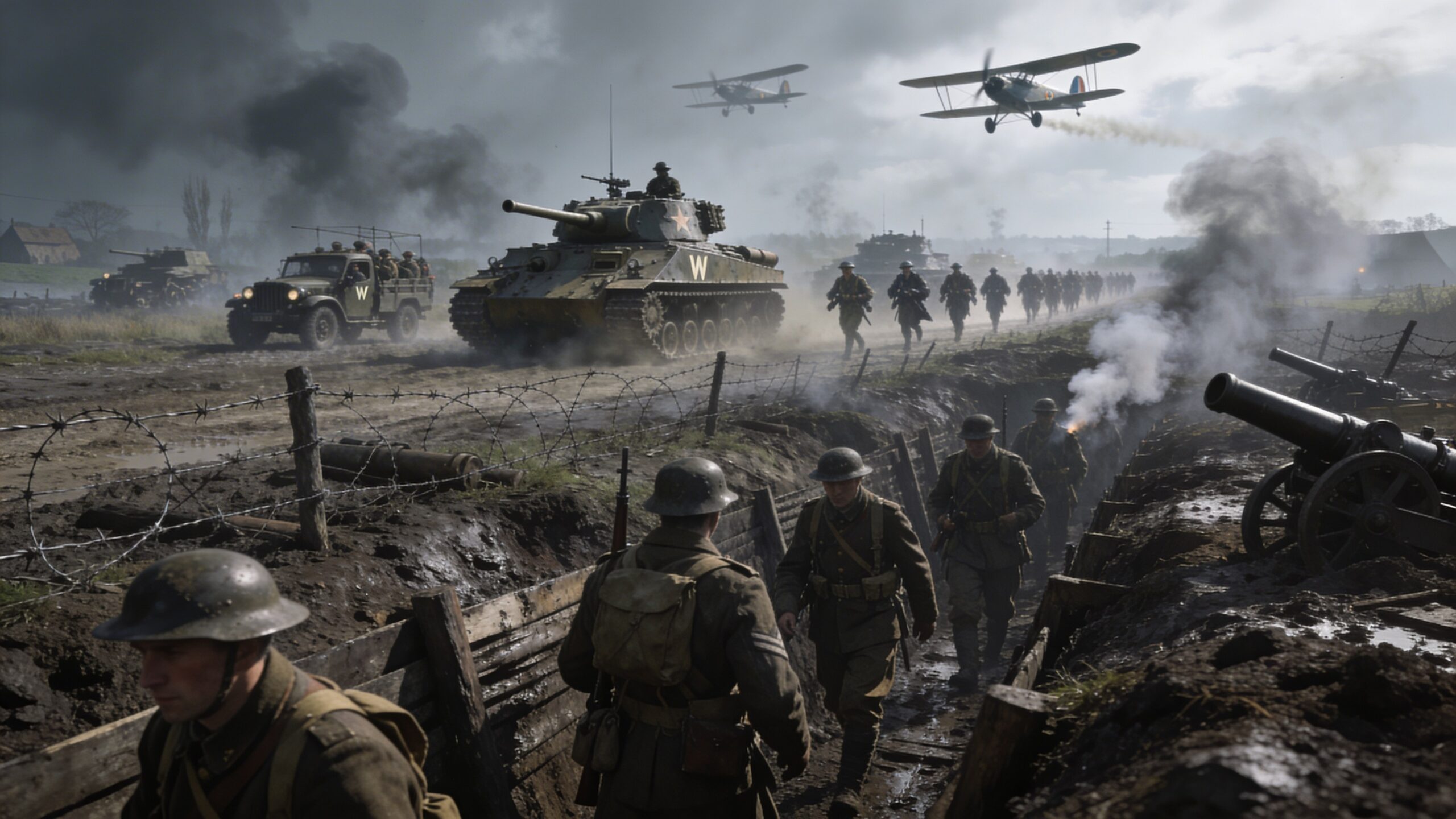
By late 1914, the Western Front had stabilized into a continuous network of trenches stretching from the North Sea to Switzerland. These trenches were designed to provide protection from artillery and machine-gun fire. Life in the trenches was harsh and dangerous. Soldiers endured mud, cold weather, constant shelling, and the ever-present threat of attack. Between the opposing trench lines lay a devastated landscape known as no man’s land, filled with barbed wire, craters, and unexploded artillery shells. Trench warfare created a deadly stalemate. Advances were difficult because machine guns and artillery made open assaults extremely dangerous. Armies could gain small sections of territory at enormous cost, but decisive breakthroughs remained rare. This new form of warfare defined much of the conflict that followed.
The Expansion of a Global War
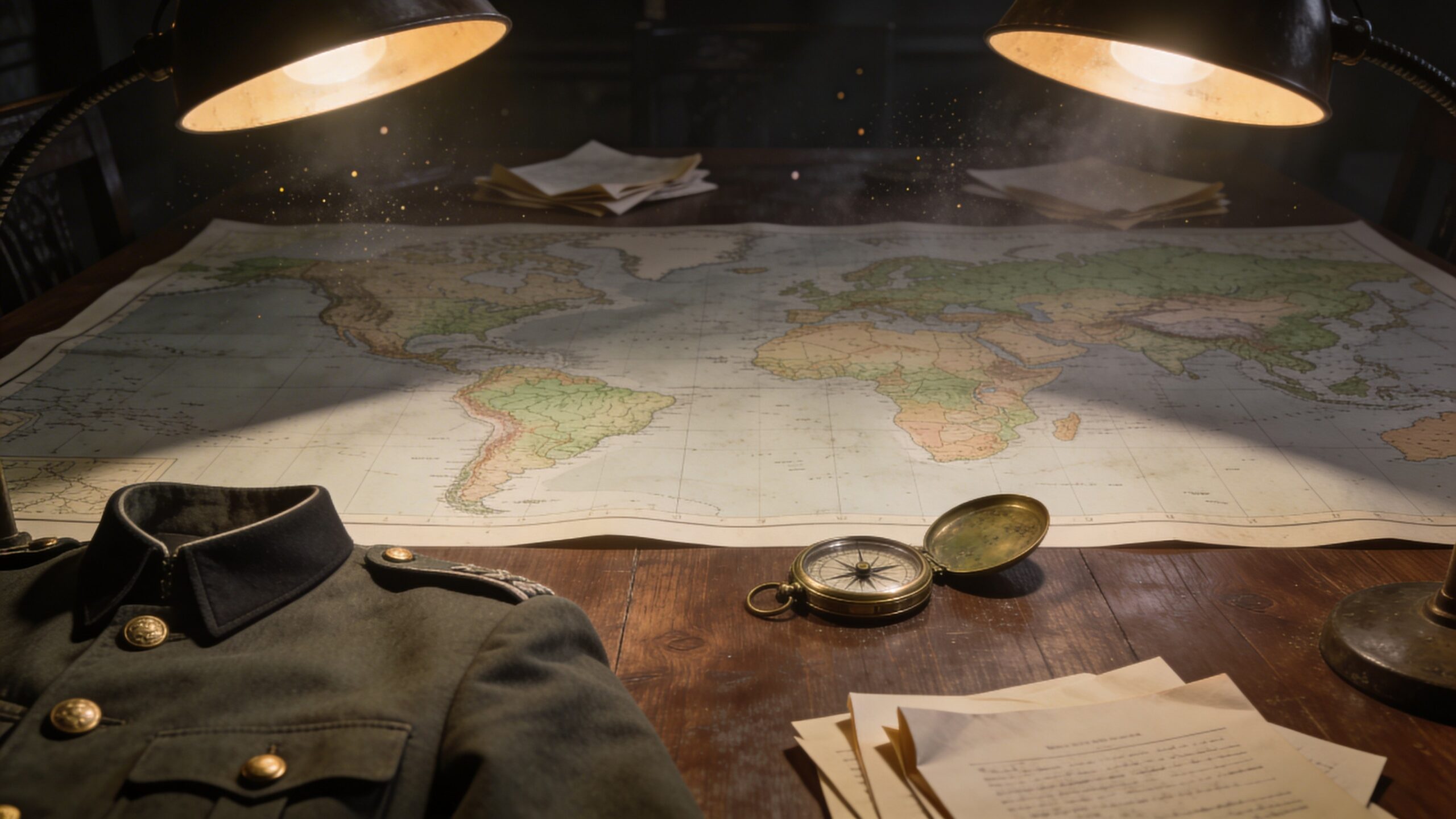
Although the Western Front became the most famous battlefield of World War I, the conflict soon expanded far beyond Western Europe. Fighting erupted across multiple regions as empires mobilized their global resources. In Eastern Europe, Germany and Austria-Hungary fought against Russia across vast territories. Battles were more mobile than those on the Western Front, with armies maneuvering across hundreds of miles of terrain. The Ottoman Empire joined the Central Powers in 1914, opening new fronts in the Middle East and the eastern Mediterranean. Campaigns took place in Gallipoli, Mesopotamia, and the Arabian Peninsula.
Colonial territories also became battlegrounds. African and Asian colonies were drawn into the conflict as imperial powers deployed troops and resources from around the world. By 1915, the war had become a truly global conflict.
The Brutal Battles of 1916
Two of the most devastating battles of World War I occurred in 1916: Verdun and the Somme. The Battle of Verdun began in February 1916 when German forces launched a massive offensive against French defenses. The battle lasted nearly a year and became a symbol of national resistance for France. Hundreds of thousands of soldiers were killed or wounded as both sides fought for control of strategic positions.
Later that year, Allied forces launched the Battle of the Somme in an attempt to relieve pressure on Verdun. The offensive began with one of the largest artillery bombardments ever conducted at the time. When infantry advanced across no man’s land, they encountered intense machine-gun fire. The first day of the Somme remains one of the deadliest days in British military history. Although the Allies eventually gained some territory, the battle resulted in enormous casualties on both sides.
These battles demonstrated the devastating cost of trench warfare.
Technological Changes in Warfare
World War I introduced new technologies that transformed how wars were fought. Machine guns, heavy artillery, and barbed wire made defensive positions extremely powerful. Poison gas was introduced as a weapon in 1915. Chlorine and mustard gas caused severe injuries and psychological terror among soldiers. Although protective equipment was developed, gas warfare added another layer of danger to the battlefield.
Tanks were introduced later in the war as a means of breaking the trench stalemate. Early tanks were slow and unreliable, but they represented a new form of mechanized warfare that would become increasingly important in future conflicts. Airplanes also played a growing role in reconnaissance and combat. Pilots conducted aerial observation missions and eventually engaged in dogfights above the battlefield. These technological innovations signaled a new era of industrial warfare.
The United States Enters the War
By 1917, the war had already lasted far longer than most leaders expected. Millions of soldiers had been killed or wounded, and many nations were struggling to sustain their war efforts. The United States had remained neutral during the early years of the conflict. However, several developments shifted American opinion. German submarine attacks on merchant shipping threatened American lives and commerce. The discovery of diplomatic messages suggesting a German alliance with Mexico further alarmed the United States. In April 1917, the United States declared war on Germany and joined the Allied coalition. American industrial strength and military manpower provided new momentum for the Allied war effort. Although American troops required time to train and deploy, their arrival significantly altered the balance of power on the Western Front.
The Collapse of Empires
The year 1917 also brought dramatic political change in Eastern Europe. Russia experienced two revolutions that overthrew the existing government and eventually brought the Bolsheviks to power. The new leadership sought to withdraw from the war, signing the Treaty of Brest-Litovsk with Germany in early 1918. This allowed Germany to shift troops from the Eastern Front to the Western Front in a final attempt to win the war.
Meanwhile, economic hardship and military defeats weakened several major empires. Austria-Hungary and the Ottoman Empire faced growing instability, while Germany struggled with declining morale and shortages of resources. The political structure of Europe was beginning to unravel.
The Final Year of the War
In 1918, Germany launched a series of major offensives on the Western Front in an effort to achieve victory before American forces arrived in large numbers. These attacks initially achieved significant gains, pushing Allied lines back across portions of France. However, the offensives ultimately failed to break Allied resistance. Reinforced by American troops and improved coordination, Allied forces launched a counteroffensive known as the Hundred Days Offensive.
This sustained campaign gradually pushed German forces back across the Western Front. By the autumn of 1918, the Central Powers were collapsing. Bulgaria surrendered in September, followed by the Ottoman Empire and Austria-Hungary. Germany faced internal unrest and political upheaval.
The Armistice and the End of War
On November 11, 1918, Germany agreed to an armistice with the Allied powers. Fighting on the Western Front ceased at 11 a.m., bringing an end to four years of devastating conflict. World War I had transformed the political landscape of Europe. Several empires—including the German, Austro-Hungarian, Ottoman, and Russian empires—collapsed during or immediately after the war. New nations emerged across Central and Eastern Europe as borders were redrawn. Although the war had ended, the peace that followed proved fragile.
The Legacy of the Great War
The Treaty of Versailles formally ended the war in 1919, imposing heavy penalties on Germany and reshaping international borders. The treaty also established the League of Nations, an early attempt to create an international organization dedicated to preventing future conflicts. World War I left deep scars across the world. Entire regions had been devastated, millions of lives were lost, and political systems had been permanently altered.
Yet the war also reshaped modern society in profound ways. Military technology, international diplomacy, and national identities were all influenced by the experiences of the conflict. The Great War marked the beginning of a new and uncertain era in global history.