The Fragile Peace After World War I
The roots of World War II can be traced directly to the aftermath of World War I. When the first global conflict ended in 1918, the world was exhausted by years of devastating warfare. Millions of soldiers had died, entire regions were destroyed, and several powerful empires had collapsed. Although the war ended with an armistice and a formal peace treaty, the settlement that followed failed to create lasting stability. Instead, the political and economic conditions of the postwar era created an environment filled with resentment, uncertainty, and unresolved conflict. The Treaty of Versailles, signed in 1919, imposed severe penalties on Germany. The country was forced to accept responsibility for the war, surrender territory, reduce its military strength, and pay massive financial reparations. Many Germans viewed these conditions as humiliating and unjust, and the treaty quickly became a symbol of national resentment. This atmosphere of anger and instability would later become a powerful force in shaping the political landscape of Europe.
A: Germany’s invasion of Poland on September 1, 1939.
A: It imposed heavy penalties on Germany and created lasting resentment.
A: Economic hardship weakened governments and encouraged extremist movements.
A: Germany, Italy, and Japan formed the core Axis alliance.
A: Several nations sought territorial control and resource dominance.
A: International organizations lacked enforcement power and unity.
A: Some nations allowed territorial concessions to avoid immediate conflict.
A: Japan expanded militarily across East Asia and the Pacific.
A: After the attack on Pearl Harbor in December 1941.
A: It helps explain how global tensions can escalate into major conflicts.
Economic Collapse and Global Instability
Economic turmoil during the 1920s and 1930s further destabilized the international system. After World War I, many countries struggled to rebuild their economies and repay wartime debts. The situation worsened dramatically when the Great Depression began in 1929. The global financial crisis triggered massive unemployment, collapsing industries, and widespread poverty across many nations.
Economic desperation often creates fertile ground for political extremism. In several countries, democratic governments struggled to address the crisis effectively. As frustration and fear spread, radical political movements began gaining support.
Many people became willing to support leaders who promised national revival, economic recovery, and restored pride. In some cases, these promises came from authoritarian regimes that rejected democratic principles. Economic collapse therefore played a critical role in shaping the political conditions that led to World War II.
The Rise of Authoritarian Regimes
One of the most significant forces behind the outbreak of World War II was the rise of authoritarian governments in several major nations. In Germany, Adolf Hitler and the Nazi Party rose to power by exploiting public anger over economic hardship and national humiliation. Hitler promised to restore German strength, rebuild the military, and reclaim territories lost after World War I.
Italy also embraced authoritarian leadership under Benito Mussolini. Mussolini sought to rebuild a powerful empire modeled after ancient Rome and pursued aggressive expansion in Africa and the Mediterranean. In Asia, Japan’s military leadership increasingly dominated the government and pursued expansion across East Asia in order to secure resources and influence. These governments shared several characteristics. They promoted nationalism, centralized power, suppressed political opposition, and pursued territorial expansion. Their aggressive ambitions dramatically increased the risk of global conflict.
Expansionism and Territorial Ambitions
Another major cause of World War II was the pursuit of territorial expansion by several nations seeking greater power and resources. Japan began expanding its influence in East Asia during the early 1930s. In 1931, Japanese forces invaded Manchuria in northeastern China, establishing control over a large region rich in natural resources.
Italy followed a similar strategy by invading Ethiopia in 1935. Despite international condemnation, the invasion succeeded, demonstrating the weakness of global diplomatic institutions. Germany soon began pursuing territorial ambitions as well. Hitler argued that Germany needed additional land to support its population and economic growth. This concept, often referred to as “living space,” became a central component of Nazi ideology.
Germany gradually violated the restrictions imposed by the Treaty of Versailles. The country rebuilt its military, reoccupied the Rhineland, and annexed neighboring territories such as Austria. Each expansionist move increased tensions across Europe.
The Failure of International Diplomacy
During the interwar period, several international organizations attempted to preserve peace and prevent future conflicts. The most prominent of these institutions was the League of Nations, created after World War I to encourage cooperation between countries. However, the League of Nations struggled to enforce its decisions. Many countries were reluctant to confront aggressive powers directly, especially when economic and military resources were limited.
When Japan invaded Manchuria and Italy attacked Ethiopia, the League issued condemnations but failed to stop the aggression. These failures undermined confidence in international diplomacy and demonstrated that expansionist governments could act without serious consequences. Diplomatic negotiations also struggled to contain Germany’s ambitions. Several European leaders hoped that accommodating some of Germany’s demands might prevent a larger conflict. This strategy became known as appeasement.
Appeasement and the Road to War
Appeasement was a policy pursued primarily by Britain and France during the late 1930s. Many leaders hoped that allowing Germany limited territorial concessions might satisfy Hitler’s ambitions and prevent another devastating war. One of the most famous examples occurred in 1938 during the Munich Agreement. European leaders allowed Germany to annex the Sudetenland, a region of Czechoslovakia with a significant German-speaking population.
The agreement was presented as a way to preserve peace. However, instead of stopping Germany’s expansion, it encouraged further aggression. Within months, Germany occupied the rest of Czechoslovakia. It became increasingly clear that diplomatic concessions would not prevent further conflict.
The path toward war was becoming unavoidable.
The Invasion of Poland
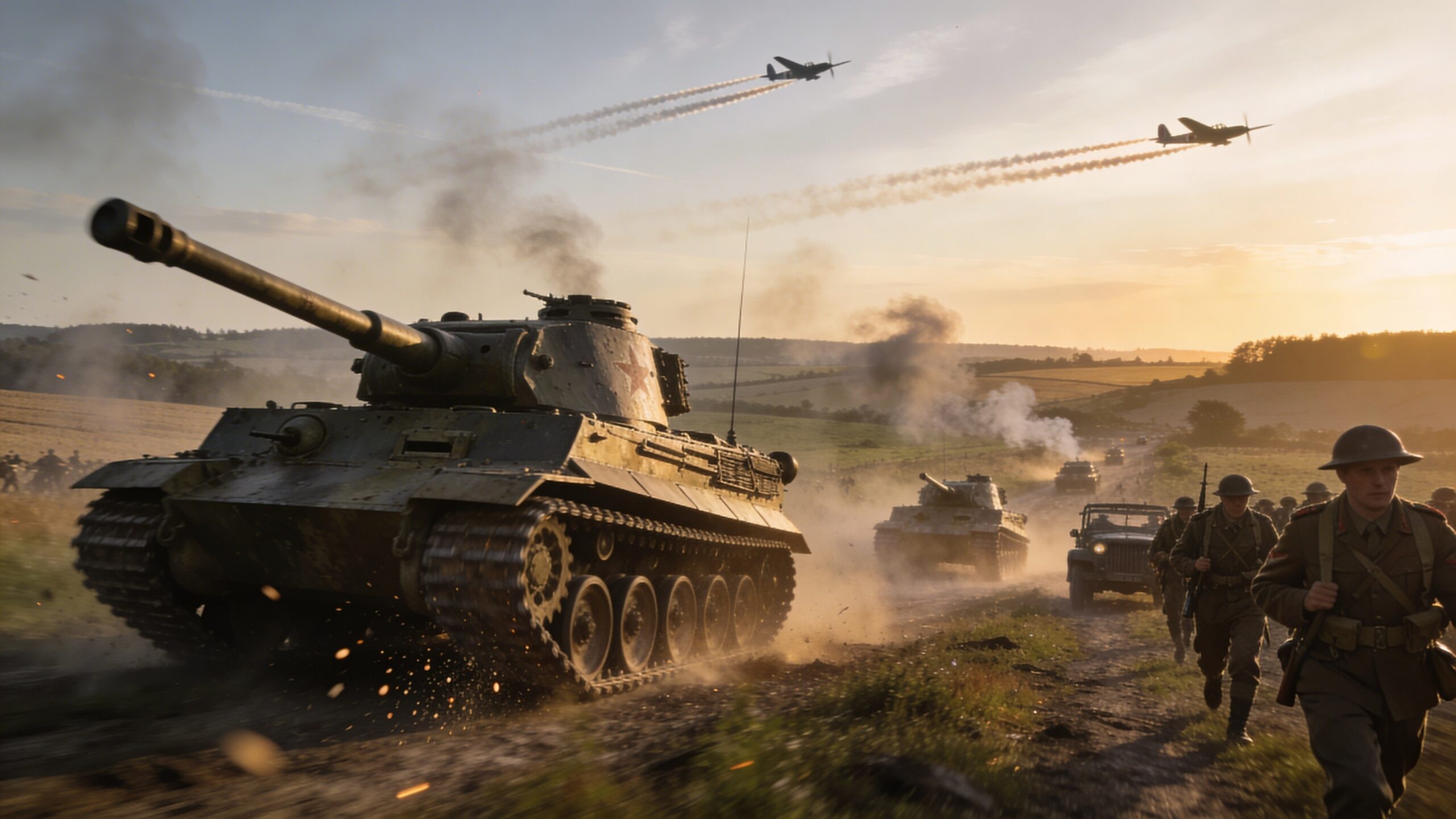
The immediate trigger for World War II occurred in September 1939 when Germany invaded Poland. The attack used a new military strategy that combined tanks, aircraft, and fast-moving infantry to overwhelm defenses rapidly. The invasion shocked the world and confirmed that Germany intended to pursue large-scale conquest.
Britain and France had previously pledged to defend Poland in the event of aggression. When Germany launched its attack, both countries declared war on Germany. What began as a regional invasion quickly escalated into a global conflict.
A Conflict That Spanned Continents
Although the invasion of Poland marked the official beginning of World War II, the conflict soon expanded far beyond Europe. Japan’s war in China intensified, drawing additional nations into the struggle across East Asia. In 1941, the Japanese attack on Pearl Harbor brought the United States into the war, transforming the conflict into a truly global confrontation. Battles soon erupted across Europe, North Africa, the Atlantic Ocean, and the Pacific Islands. The scale of the war became unprecedented in human history.
Ideology and Global Power
World War II was not only a struggle over territory and resources. It was also a conflict shaped by competing political ideologies. Authoritarian regimes promoted militarism, nationalism, and expansion. Democratic nations and other allied powers sought to resist these ambitions and maintain a balance of international power. This ideological conflict helped intensify the war’s scale and urgency. Nations viewed the outcome of the war as determining the future political structure of the world.
The Deadliest Conflict in Human History
World War II ultimately became the most destructive conflict humanity had ever experienced. Tens of millions of soldiers and civilians lost their lives, entire cities were destroyed, and economies across the world were reshaped. Yet the war also transformed international politics, technology, and global cooperation. Institutions such as the United Nations emerged in the aftermath as nations attempted to prevent future conflicts of similar magnitude.
The war’s origins remind us that global conflicts rarely begin with a single event. Instead, they emerge from a complex combination of political tensions, economic pressures, ideological struggles, and strategic miscalculations. Understanding these forces helps explain how the world descended into one of the most devastating wars in history—and why studying its causes remains essential for understanding modern geopolitics.