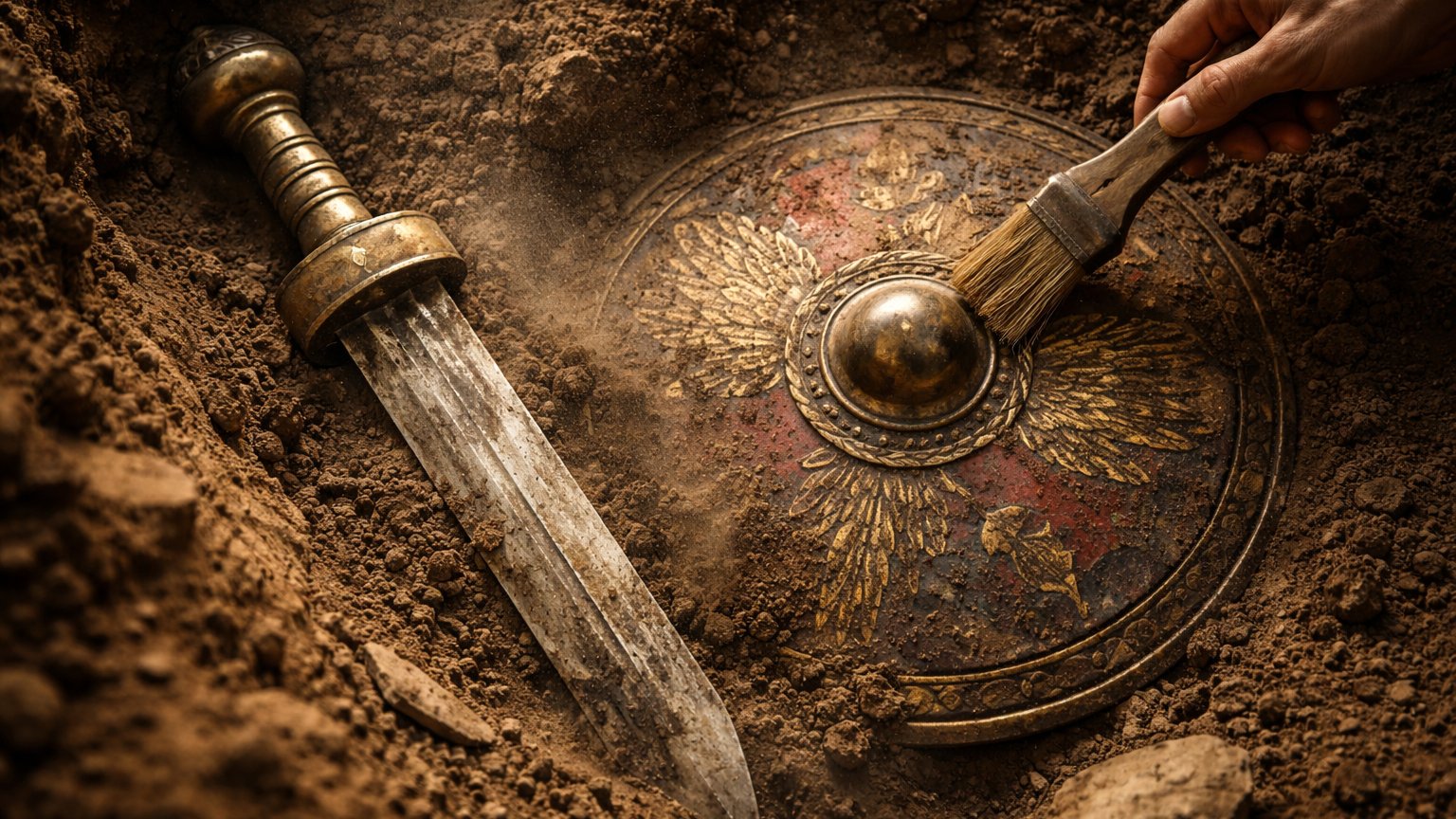
When History Refuses to Stay Buried
Some of the most extraordinary discoveries in military history were never made by carefully planned expeditions. They were found by accident. A farmer cutting a new drainage trench, a construction crew widening a road, a hiker following an unfamiliar path, or a storm tearing away layers of earth can suddenly expose objects that have not seen daylight for centuries. In those moments, the past stops being distant and becomes immediate, physical, and impossible to ignore. Battlefield relics discovered by accident fascinate people because they combine two powerful forces: the drama of war and the shock of surprise. These finds are not simply old objects. They are fragments of real events, often preserved exactly where chaos left them. A buried musket ball, a broken sword hilt, a soldier’s buckle, or a collapsed trench can change how historians understand a battle, a campaign, or even an entire era. What was once based on official reports, legends, and assumptions suddenly gains hard evidence.
A: Many battlefields were never fully excavated and now lie beneath active land use.
A: Its context, condition, location, and connection to a specific event or unit.
A: Not always; personal items and grave evidence can be even more revealing.
A: Yes, especially when it contradicts accepted maps or written accounts.
A: Battlefield interpretation depends on how artifacts relate to terrain and one another.
A: Leave it in place when possible and report it to the proper authority or archaeologist.
A: Yes, especially in older cities and historically contested regions.
A: Yes, they require respectful legal and archaeological procedures immediately.
A: Absolutely; erosion, flooding, and drought can uncover hidden relics and positions.
A: They combine surprise, material evidence, and the drama of rediscovering lost history.
Why Accidental Battlefield Finds Matter So Much
Battlefields are unlike many other historical sites because they are places of intense action compressed into short, violent periods of time. Objects dropped, buried, shattered, or abandoned there are often tied directly to specific moments. That makes battlefield relics uniquely valuable. A coin in an old market town might tell you something about trade. A cluster of musket balls on a battlefield can help reveal troop movement, firing direction, and tactical pressure.
Accidental discoveries are especially important because they often occur in places scholars were not actively studying. That matters more than it may seem. Historians, archaeologists, and preservationists can only investigate so much terrain at once, and many battlefields remain hidden beneath farms, forests, suburbs, and city streets. When relics surface unexpectedly, they can open entirely new lines of inquiry. They may confirm that a battle happened where tradition said it did, or they may prove that accepted maps were wrong all along.
The Farmer, the Builder, and the Hiker
A remarkable number of battlefield finds begin with ordinary people doing ordinary things. Farmers have uncovered cannonballs while plowing fields. Builders have exposed mass graves and weapons caches during excavation projects. Walkers and hikers have stumbled onto rusted fragments in woodland that once served as military ground. In each case, the discovery begins not with scholarship, but with coincidence. That accidental quality gives these discoveries a special power. It reminds us that history is layered directly beneath modern life. The field producing crops today may once have been filled with cavalry charges and artillery smoke. A suburban development may stand on land where soldiers made a desperate last defense. A forest trail may wind through what used to be a camp, a trench line, or the edge of an ambush. Battlefield relics discovered by accident force people to realize that the past is not sealed off in museums. It is still embedded in the ground beneath roads, homes, and towns.
Weapons That Surface Without Warning
Among the most dramatic accidental finds are weapons. Swords, spearheads, pistols, muskets, bayonets, and artillery fragments create an immediate emotional reaction because they are so clearly tied to conflict. Even in damaged condition, they carry a sense of urgency and danger. When a construction crew uncovers a line of rusted muskets or a drainage project reveals a buried ammunition cache, the discovery feels cinematic. Yet its real importance is usually historical, not theatrical.
Weapons reveal more than the fact that fighting happened. Their design, distribution, and condition help explain how a battle unfolded. A concentration of spent ammunition can show where troops held their line. Broken blades may indicate close combat. Improvised repairs on metal parts can suggest prolonged hardship or supply shortages. Accidental discoveries of battlefield weapons often help historians move beyond official battle accounts and see how combat was really experienced on the ground.
Personal Belongings That Make War Human Again
Not every powerful relic is a weapon. In fact, some of the most moving battlefield finds are deeply personal. Buttons, rings, coins, belt plates, combs, pipe stems, eating utensils, uniform fragments, and handwritten items transform war from a strategic abstraction into a human reality. These objects remind us that every battlefield was filled not just with armies, but with individuals carrying ordinary things into extraordinary danger. When such items are discovered by accident, their emotional force can be overwhelming. A lost coin purse suggests someone expected to live long enough to spend it. A broken buckle or torn insignia hints at the violence of movement and collapse. A spoon near a trench line can speak as loudly as a weapon because it suggests hunger, waiting, routine, and fatigue. Personal relics change history not by rewriting tactics, but by restoring the people within the story.
Forgotten Graves and the Weight of Discovery
Some accidental battlefield finds are sobering in a different way. Human remains, burial pits, and field graves are occasionally uncovered during road building, agricultural work, or erosion events. These discoveries shift the conversation immediately. What began as a search for land, materials, or infrastructure becomes an encounter with loss on a deeply personal scale.
Such finds can change history in several ways. They may reveal that casualty counts were inaccurate, that soldiers were buried where no records survived, or that entire engagements left larger traces than historians realized. They can also bring long-overdue recognition to those who disappeared from the record. Battlefield archaeology is never just about weapons and treasure. It is also about dignity, memory, and the difficult task of honoring people whose final moments were hidden for generations.
Weather, Erosion, and Nature as Unexpected Archaeologists
Nature is one of the greatest accidental discoverers of battlefield relics. Heavy rain can strip away topsoil and expose metal objects. Riverbank erosion can reveal buried camps or firing positions. Storms can tear through coastlines and uncover fortifications, ship debris, and military remains. Drought can lower water levels enough to expose crossings, abandoned equipment, and submerged structures once tied to conflict. These natural processes are both helpful and destructive. They can reveal sites that would otherwise remain hidden, but they can also damage fragile context by scattering or eroding objects further. Still, many major battlefield discoveries begin this way. A flood reveals an old embankment. A landslide exposes a line of artifacts. A melting patch of frozen ground releases gear that has remained untouched for generations. In these cases, the landscape itself becomes an unwitting archaeologist, forcing history into view.
Construction Projects and History Beneath Modern Cities
Urban growth has produced some of the most important accidental battlefield finds in modern times. Roads, foundations, utility trenches, and rail work often cut through ground that has not been deeply disturbed in centuries. When that happens, relics can appear in sudden, startling concentrations. Buckles, bullets, coins, pottery, weapons, horse fittings, and fortification remnants can all emerge from sites that looked completely ordinary from the surface.
These discoveries are significant because they reveal how thoroughly modern life overlays older conflict zones. Many decisive battle areas are now parts of active cities and towns. As development expands, it often collides with forgotten layers of warfare. This does more than create delays for construction teams. It forces communities to confront the fact that their streets and neighborhoods may rest on contested ground. In some cases, accidental finds during development have led to major archaeological work, site protection, and even revisions to local historical identity.
How One Accidental Find Can Rewrite a Battle
Battle history is often built from written accounts, but written accounts are imperfect. Commanders exaggerated victories, concealed failures, misunderstood terrain, or never saw the entire field. Soldiers remembered events from limited vantage points. Later historians sometimes treated those accounts as fixed truth. Then a relic is found in the wrong place, and everything changes. A cluster of shot where no fighting was supposed to occur may suggest a flank movement. A buried artillery position can prove that troops were placed differently than maps indicated. A concentration of personal objects may show where soldiers paused, retreated, or regrouped. Even a single find can trigger larger questions. Why was this here? What does it imply about timing, pressure, confusion, or retreat? Accidental battlefield discoveries are powerful precisely because they do not begin with theory. They begin with evidence.
Treasure, Myth, and the Public Imagination
The phrase battlefield relics often brings treasure to mind, and that is understandable. Gold coins, military pay chests, ceremonial weapons, and hidden caches capture public imagination immediately. Yet the most important battlefield treasures are not always the most expensive. A bag of coins matters, but so does a scatter of ordinary hardware if it reveals where a line broke under pressure. A jeweled officer’s sword may be visually impressive, but a humble belt hook can be more useful in reconstructing troop position.
Still, the treasure element matters because it draws public attention toward preservation. Stories of accidental discoveries often spread quickly because they feel dramatic and cinematic. That attention can be useful when it leads to site protection and deeper research. The challenge is making sure the excitement does not overshadow the historical value. Battlefield relics are not just collectibles. They are evidence, context, and memory held in material form.
The Role of Responsible Reporting
Because many accidental discoveries are made by non-specialists, the response after the find matters enormously. Moving objects without recording location can destroy context. Selling items privately can erase information that scholars need. Failing to notify the proper authorities can turn an important historical site into a lost opportunity. The most valuable accidental finds are often preserved not because they were found by experts, but because the people who found them acted responsibly. Responsible reporting allows archaeologists and historians to study the wider setting, not just the individual object. That is critical on battlefields, where the relationship between items often matters as much as the items themselves. A relic lifted from the ground is interesting. A relic documented in exact relation to nearby artifacts, soil layers, and terrain features can be transformative. Modern battlefield history depends not only on discovery, but on what happens in the minutes and hours afterward.
Why These Finds Continue to Change History
Battlefield relics discovered by accident continue to change history because they operate outside expectation. They emerge from forgotten places, contradict neat narratives, and restore detail where memory had gone vague. Their power comes from their immediacy. They are not distant interpretations. They are direct survivors of violence, movement, fear, and endurance.
Every accidental battlefield discovery carries two stories at once. The first is the story of the war itself: the clash, the retreat, the survival, the loss. The second is the story of rediscovery: the field reopened, the ground disturbed, the object lifted back into view after generations of silence. Together, those stories remind us that history is never fully settled. It waits in the soil, in riverbanks, beneath highways, and under forest roots, ready to challenge what we think we know.
The Past Still Waits Beneath Our Feet
What makes accidental battlefield finds so compelling is not just their rarity, but their ability to collapse time. A laborer with a shovel or a farmer on a tractor can suddenly become the first person in centuries to touch a relic from a moment of extreme human conflict. In that instant, the boundary between present and past disappears. That is why these discoveries matter so deeply. They do more than add objects to collections or details to textbooks. They reveal that history remains unfinished until the ground gives up its evidence. Somewhere beneath modern fields, streets, coastlines, and woodlands, more relics still wait. Some will emerge through research. Others will appear suddenly, by accident, changing the historical record all over again.